
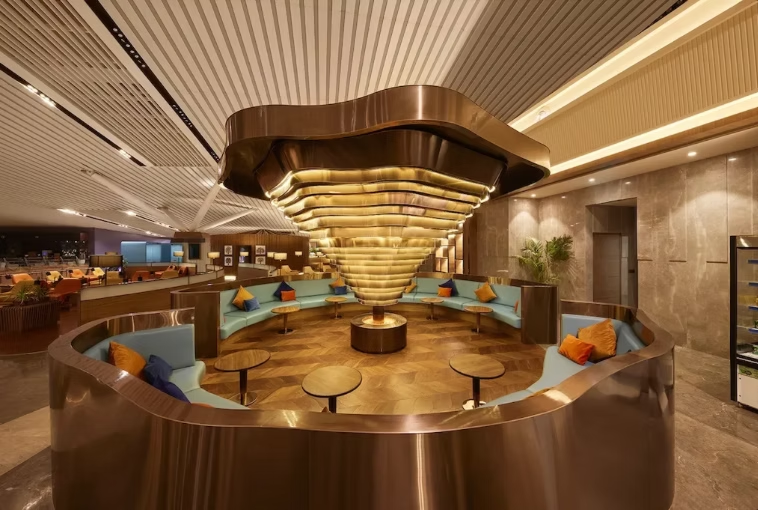
95% – that is how much of India’s airport lounge market DreamFolks held, a clear monopoly play on the Indian premiumisation story.
Yet, in 9 months, this monopoly has somehow disappeared with a string of mistakes that have led to a 70% crash in the company’s stock price during that time!
This isn’t just another corporate earnings miss; it’s the spectacular fall of DreamFolks Services, India’s airport lounge aggregation king, brought to its knees by an unlikely adversary: Adani Group.
What started as a tech-enabled democratisation of luxury airport experiences has devolved into a cautionary tale of how even the most dominant monopolies can crumble when infrastructure owners decide to cut out the middleman.
The Dream For Airport Folks

In 2013, when Liberatha Peter Kallat launched DreamFolks Services, India’s aviation sector was experiencing unprecedented growth, but airport lounge access remained fragmented and elitist.
Armed with a science degree from Andhra University and experience across hospitality giants like Taj Hotels, PepsiCo, and Plaza Premium Group, Kallat identified a glaring market inefficiency: banks were negotiating separately with dozens of lounge operators across India’s expanding airport network, creating a coordination nightmare.
Kallat’s eureka moment was elegantly simple yet revolutionary. Instead of each bank wrestling with individual lounge operators, DreamFolks would become the unified technology bridge, aggregating all stakeholders onto a single platform with asset-light perfection (they owned no lounges).
The numbers tell the story of DreamFolks’ meteoric rise. From humble beginnings facilitating Mastercard’s lounge access program in 2013, the company grew exponentially, achieving a 95% market share in India’s card-based lounge access market by 2022. The financial trajectory? Just see for yourself!
Year | Revenue (Rs. crore) | Net Profit (Rs. crore) | Net Margin (%) |
FY22 | 284 | 16 | 5.7% |
FY23 | 773 | 73 | 9.4% |
When DreamFolks went public in September 2022, the IPO was oversubscribed 56x, listing at a spectacular 56% premium, validating investor confidence in Kallat’s vision. At its peak in September 2024, DreamFolks commanded a stock price of Rs. 522, making it the undisputed champion of India’s airport lounge ecosystem!
By FY24, DreamFolks facilitated access for approximately 11 million passengers**,** hitting a revenue number of Rs. 1,135 crore – and just when things were hunky dory, they were suddenly not.
The Achilles’ Heel
Even at its zenith, DreamFolks exhibited structural vulnerabilities that astute observers could have spotted. Despite revenue growth, net profit margins were declining. From 9.4% in FY23 to 6.1% in FY24. Lounge volumes remained flat despite growing passenger traffic and credit card issuance, indicating that DreamFolks’ growth was becoming increasingly dependent on pricing rather than volume expansion.
The company’s dependence on airport lounges was extreme – 93% of its revenue came from this single vertical, creating dangerous exposure to any disruption in lounge access, and that is exactly what happened

September 22, 2024 marked the day DreamFolks’ monopoly began to crumble. What the company diplomatically called “a temporary disruption in services” was, in reality, a complete system failure that shut down lounge access at 49 lounges across 34 airports nationwide.
The impact was immediate and devastating: thousands of premium cardholders were denied lounge access, Travel Food Services threatened legal action, and Adani Airports publicly blamed DreamFolks for violating service agreements.
Although DreamFolks resolved the technical issue within 24 hours, the damage was irreversible. The disruption exposed the single point of failure risk in their business model and shattered the trust that had taken years to build.
The September disruption triggered a domino effect that continues to reverberate. By June 2025, major banks and card networks, including ICICI Bank, Axis Bank, and Mastercard, were actively seeking direct partnerships with airport lounge operators, with American Express becoming the first major defector.
Financial results for FY25 reflected this deteriorating position. While revenue grew 14% to Rs 1,292 crore, net profit declined 5% to Rs 65 crore, and margins compressed to their lowest levels in years – 5% – and unfortunately, this wasn’t the end.
The Nightmare That Followed

The September 2024 disruption handed Arun Bansal, CEO of Adani Airport Holdings, the perfect opportunity to execute a strategy that had been years in the making.

This wasn’t mere corporate posturing—it was a declaration of war backed by overwhelming strategic advantages. Adani’s assault on DreamFolks’ monopoly rested on 3 devastating pillars that would prove impossible to counter:
1. Infrastructure Monopoly
Operating 7 major airports – Mumbai, Ahmedabad, Lucknow, Jaipur, Guwahati, Thiruvananthapuram, and Mangaluru, Adani controls critical gateways handling 96 million passengers annually (60% of the country).
Airport | Passengers (FY25) | Strategic Importance |
Mumbai T1 & T2 | 55.3M | Financial capital gateway |
Ahmedabad | 13.6M | Western India hub |
Lucknow | 7.0M | North India access |
Jaipur | 6.1M | Tourism gateway |
Guwahati | 6.7M | Northeast gateway |
Thiruvananthapuram | 4.9M | South India access |
Mangaluru | 2.4M | Coastal hub |
2. LoungeOne Platform
By cutting out DreamFolks’ intermediation, banks could eliminate commission fees, gain direct customer data, and enjoy real-time system reliability. The first customer to shift from DreamFolks to Adani? Mastercard. From then on, platform launched across 16 airports with partnerships from major banks including ICICI Bank and Axis Bank, offering QR code generation, real-time card validation, and seamless integration with Adani’s broader ecosystem.
3. Coercive Power
According to Liberatha Kallat’s explosive interview with CNBC TV-18, Adani’s approach was unambiguously threatening: “The pressure which has been built up is to tell the clients that, in case they do not sign up with them or do business with them directly, they would actually stop their cardholder access to their airports.”
The implications were existential for DreamFolks. Losing access to Adani’s airports meant losing 23% of India’s lounge traffic. For banks, the choice became binary: partner directly with Adani or risk denying their premium cardholders access to India’s most critical airports. It was an ultimatum that few financial institutions could afford to ignore.
DreamFolks had fallen into the classic monopoly trap – believing that market dominance guaranteed permanence. The company’s 95% market share created dangerous complacency, leading to insufficient innovation, over-dependence on a single revenue stream, and weak diversification efforts.
While DreamFolks created value by aggregating fragmented suppliers, it simultaneously made itself vulnerable to disintermediation when those suppliers decided to bypass the platform.
The Aftermath
The DreamFolks saga offers a sobering lesson about the fragility of intermediation models in an era of digital transformation.
Three scenarios emerge for the company’s future:
a 25% probability of successful reinvention as a diversified lifestyle services platform,
a 50% probability of gradual decline as market share erodes to 40-50%, and
a 25% probability of becoming an acquisition target for private equity or strategic buyers.
For investors, DreamFolks serves as a reminder that monopolies are temporary and competitive advantages must be constantly renewed. High market share doesn’t guarantee sustainable moats, and platform businesses remain vulnerable to supplier disintermediation.
The Indian airport lounge market, valued at approximately US$ 900 million and expected to grow at 12% CAGR for the next 5 years, now faces fundamental restructuring. This transformation creates both winners and losers: premium travellers may enjoy improved services through direct partnerships, while basic cardholders may face reduced access as banks tighten spending thresholds.
The battle between aggregators and infrastructure owners is far from over, but one thing is certain – customer experience will become the ultimate differentiator in this new competitive landscape.
The dream may be over, but the nightmare has birthed a new era in Indian aviation services. For those brave enough to navigate this turbulence, the opportunities are as significant as the risks. The only certainty is that India’s airport ecosystem will never be the same again.