
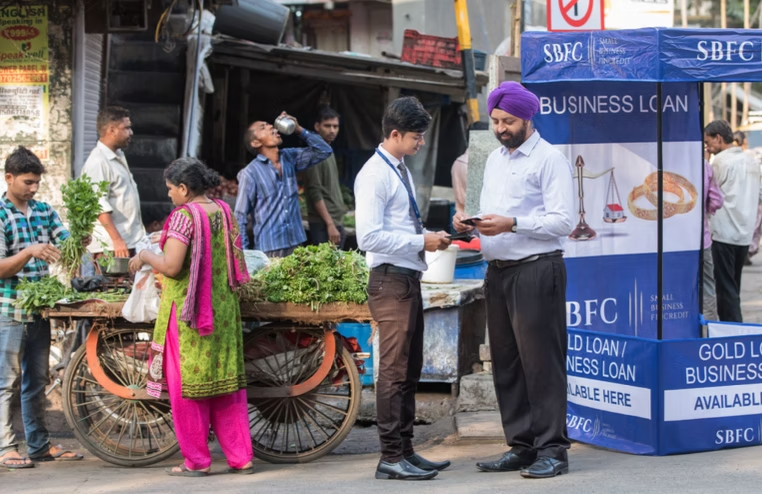
Issuing new loans worth Rs. 1 crore every 8 min – that is the breakneck speed at which a company, that sprang from the ashes of another, has been growing its balance sheet since 2020!
This is the story of a financial institution that steered through a once-in-a-century pandemic without a single unsecured rupee on its books, and still found the audacity to list at a 43% premium in 2023.
Let’s dive into the narrative of two ex-bankers who converted a Rs. 480 crore acquisition gamble into India’s fastest-growing secured-MSME franchise, why its algorithms now veto textile traders in Surat, and how a Harry Potter-inspired tech stack called “Leviosa” aims to levitate Rs. 25,000 crore in assets by 2030!
Origins: A Springboard Named Karvy

When former HDFC Bank stalwart Aseem Dhru and seasoned retail-assets strategist Mahesh Dayani set out in 2017, they bypassed the slow lane of organic branch-by-branch build-up and instead executed a bold “slump sale” acquisition of Karvy Financial Services’ secured-loan book, branch network, technology stack, and 1,350 employees.
Aseem’s two-decade stint at HDFC Bank, where he had launched retail lending, advised agribusiness clients, and chaired HDFC Securities + Mahesh’s years at Kotak Mahindra Bank taught him the alchemy of balancing credit yield with customer experience.

The Launch Years (FY18-FY20): Experimentation & Early Proof
SBFC began life as a three-product NBFC: secured MSME loans, loan-against-property (LAP), and small-ticket unsecured business loans. By FY20, its AUM crossed Rs. 1,650 crore, and yields stabilised near 15.8% despite an 80:20 North-South skew in its branch footprint.
Yet management sensed storm clouds: rising leverage among micro traders and the whiff of a broader unsecured credit cycle.


The COVID Crucible (FY21): Steel Forged in Fire
Lockdowns throttled cash flows across India’s bazaars, but SBFC’s decision to keep loans 100% secured and geographically diversified cushioned asset quality.
Gross Stage-3 (loans that are significantly past due, specifically 90 days or more) peaked at 3.4% (FY21) versus double-digit spikes at several peer NBFCs.
SBFC also secured a credit upgrade to AA – from ICRA amidst the chaos – a rarity for a four-year-old NBFC. Simultaneously, it shunned fresh unsecured lending, pivoting branch staff to collections and loan-book hygiene

The Velocity Phase (FY22-FY24): Pan-India Playbooks & Twin Engines
Armed with lessons from COVID, SBFC super-charged two growth engines:
Secured MSME Loans (ticket size Rs. 5 – 30 lakhs).
Gold Loans (average tenure < 12 months; Loan-To-Value ~ 62%).
Between FY22 and FY24, AUM rocketed from Rs. 3,190 crore to Rs. 6,820 crore – a 55% CAGR. Management opened 88 new branches, deliberately concentrating expansion in under-penetrated northern states such as Uttar Pradesh and Bihar, where competition was light and collateral registration simple.
What ended up being crucial as well, was co-originating with ICICI Bank. By FY25, 18% of borrowings were via co-origination, slicing blended cost of funds to 9.4%.

Finally, on 16th August 2023, SBFC’s Rs. 1,025 crore IPO listed at a 43% premium, handing it a Rs. 11,500 crore market cap. Post-listing, Clermont held 53%, SBI Mutual Fund 9%, and founders Aseem and Mahesh a combined 4% – skin in the game intact!
FY25: Disciplined Deceleration & Data-Driven Guardrails
Entering FY25, management spotted early softness among micro retailers post the e-commerce price wars. They tightened thresholds, hiked cut-offs, and slowed MSME disbursements to Rs. 2,670 crore (-4% YoY). Yet AUM still grew 28% to Rs. 8,750 crore, while RoA rose to 4.4% and Tier-1 remained a prodigious 35.9%—triple the regulatory minimum!

The Five-Year Astro-Chart (FY26-FY30): Ambitions & Algorithms
Management has publicly committed to 2x AUM every 3 years, targeting Rs. 25,000 crore by FY30. Four strategic struts underpin this aspiration:
Hyperlocal Branch Clustering: Expand from 205 to ~350 branches, but only after existing clusters hit Rs. 60 crore AUM per branch, avoiding the “thin-spread” curse. Furthermore, every SBFC branch must book at least Rs. 1.2 crore of fresh MSME loans for each new employee added – an internal metric displayed on branch dashboards.
AI-Infused Underwriting: The in-house Leviosa platform will feed bureau data, GST filings, and psychometric scores into machine-learning models to compress appraisal time to 48 hours. Developers named the loan-origination system after the levitation spell in J.K. Rowling’s books to remind staff that ”technology should lift, not weigh down, every credit officer.”
Affordable-Housing Foray: SBFC has reapplied for an HFC licence to tap tax-advantaged NHB refinance lines, with pilot branches ready in Odisha and Rajasthan.
Liability Alchemy: Target a 25% share of co-origination, 15% offshore ECBs, and debut green bonds by FY27—already mandate-ready with two ESG frameworks logged in FY25. Additionally, in February 2024, SBFC stopped accepting applications from textile traders in Surat after its analytics hub flagged a 90-day bill-discounting spike. That call cut potential NPA formation by Rs. 18 crore!

SBFC Finance has journeyed from a bold Karvy buyout to a pan-India, dual-engine lender that marries risk acuity with growth hunger. Its founders’ mantra- anticipate cycles, never chase froth – has guided decisions from pruning unsecured portfolios to pacing branch rollouts.
With its stock up 32% since its IPO, SBFC stands poised to script the next luminous chapter in India’s